

How to broadcast an iRacing race with OBS
Set up OBS, overlays, cameras and replays for an iRacing race, then rehearse the whole show before race night.
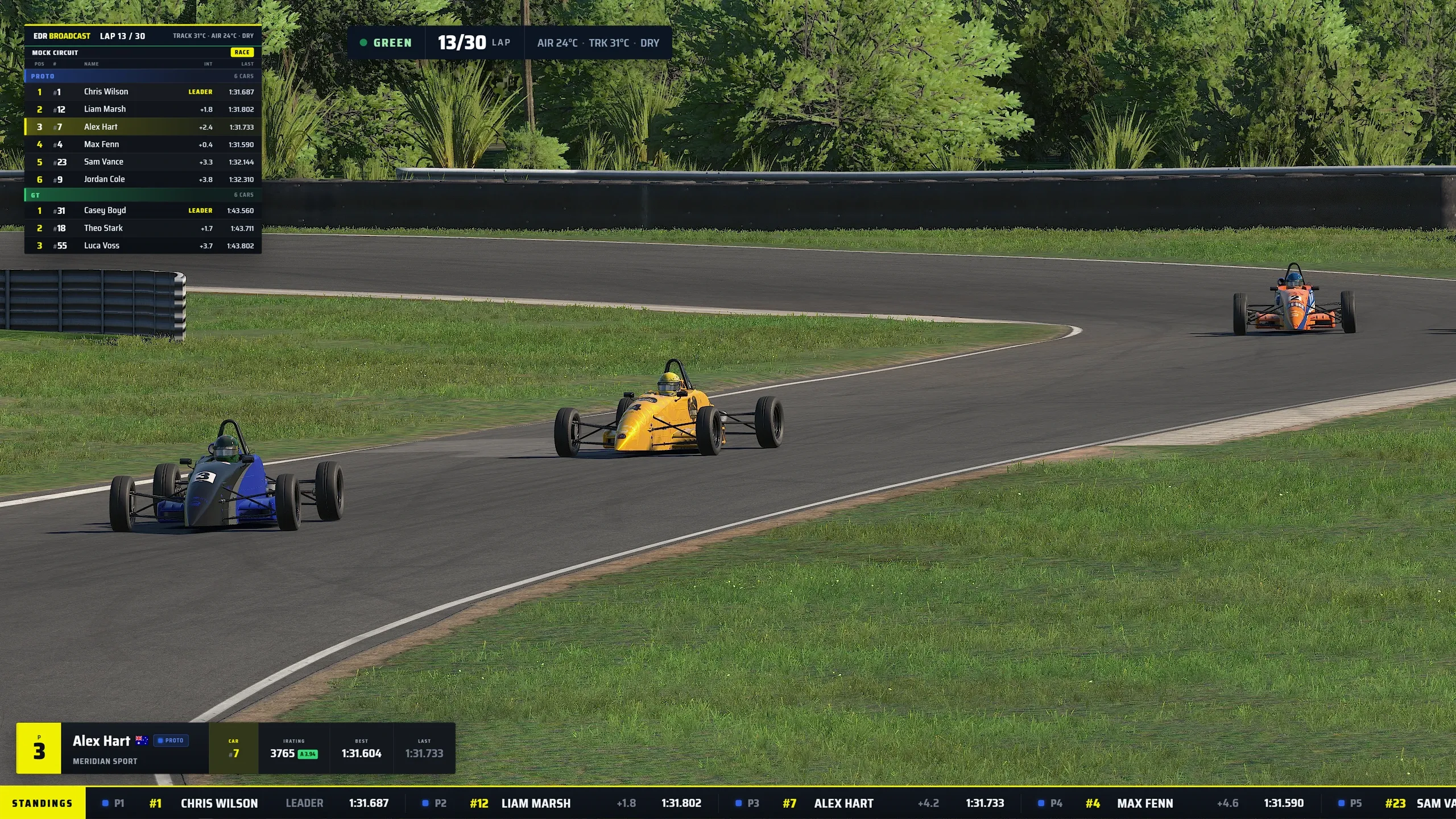
Broadcasting iRacing is mostly about workflow, not gear. You need a Windows PC running iRacing, OBS Studio to capture and stream the session, transparent browser-source overlays for timing and race graphics, and a plan for cameras and replays. What separates a watchable league broadcast from a messy one is how you set the show up before race night.
Choose the show you can support
First stream
Use game capture, clean audio, one readable timing source, flags and a standby scene. Record privately before adding replay or remote controls.
Regular league broadcast
Add focused-driver graphics, deliberate camera direction, replay labelling, a grid and results. Write a short run sheet.
Multiclass or endurance event
Add class-aware timing, pit context, incident logging, operator shifts and a tested fallback for every remote role.
What you need before race night
The stack is short. Everything here runs on one Windows PC, although a second monitor makes the job far more comfortable.
- A Windows PC with iRacing joined to the session as a spectator or broadcaster, so you have access to every car and camera.
- OBS Studio to capture iRacing, mix your audio and send the stream to Twitch, YouTube or Facebook.
- A broadcast overlay tool that outputs transparent browser sources, so timing towers, lower thirds and flags sit cleanly over the game.
- Stable upload bandwidth. Use the OBS streaming Auto-Configuration Wizard and leave upload headroom for iRacing and commentary. Platform encoder and bitrate recommendations can change, so verify the current guidance for your streaming destination.
- Commentary audio from Discord or a mixer, added as a separately controllable OBS audio source so you can balance it against engine noise. Route it to the audio track selected for streaming.
Step 1: Set up OBS to capture iRacing
Run iRacing in borderless windowed mode and add it to OBS with a Game Capture source. Game Capture is lighter on the CPU than Display Capture and it will not pick up stray windows if you alt-tab. Set your OBS canvas and output to 1920x1080, then pick an encoder: NVENC on an Nvidia card is the usual choice because it keeps the encoding load off the CPU that iRacing is already using.
Build at least three scenes before you worry about graphics: a starting-soon holding scene, the live race scene, and a break or technical-difficulties scene. Having somewhere safe to cut to buys you time when something goes wrong mid-show.
Step 2: Add overlays as browser sources
Overlays are what turn a game capture into a race show. In OBS, each overlay is a Browser source pointed at a local URL, sized to the canvas, and layered above the game capture. Because the background is transparent, the leaderboard, flag panel and lower thirds float over the racing. The OBS browser source guide covers sizing, layering and fixes in detail.
EDR Broadcast Free covers the essentials on 1 machine: a multiclass leaderboard, driver lower thirds, a standings ticker, flags, a grid intro and a podium graphic, with 2 looks. Start with the leaderboard and flags only. A clean show with three graphics reads better than a cluttered one with ten.
Step 3: Plan your cameras
Camera work is the hardest part of an iRacing broadcast and the part viewers judge you on. iRacing gives you TV cams, chase cams, onboards and blimp views for every car, but someone has to decide who to watch and when to cut. On a busy multiclass grid that decision comes up every few seconds, for the entire race.
If you have a dedicated camera operator, brief them on the championship stories before the race. If you are producing solo, this is where an auto-director earns its keep: on EDR Broadcast Pro it watches the whole field, cuts to the battles and lets you take a camera yourself whenever you want the shot.
Step 4: Handle replays and incidents
Replays are the difference between a stream and a broadcast. iRacing provides replay controls so you can revisit a pass or crash and return to the live picture, subject to the replay data available on your PC. Its native incident navigation can help find moments; a timestamped production log adds a clearer workflow for reviewing incident candidates and choosing what to show. The guide to finding and reviewing incidents on an iRacing broadcast covers that whole workflow.
Step 5: Run a full dress rehearsal
Join a practice session a few days before the event and run the entire show: overlays live, commentary connected, a test stream to an unlisted channel, and at least one replay pulled and returned cleanly. Watch the encoder stats in OBS for dropped or skipped frames while iRacing is under full load. Every problem you find in rehearsal is a problem your viewers never see.
Race-night rule. If it was not tested in a practice session, it does not go on the live show. New overlay, new scene, new audio source: rehearse it first.
Common OBS mistakes to catch
- Encoder overload. iRacing and x264 fighting for the same CPU causes stutter on stream. Use a hardware encoder or lower the preset.
- Commentary buried under engine audio. Keep game and voice as separately controllable sources, route both to the streaming audio track, and set levels during rehearsal.
- Overlays sized to the wrong resolution. Browser sources should match the canvas, usually
1920x1080, or text goes soft. - No holding scene. When the session drops or a driver disconnects, you need somewhere clean to cut to while you fix it.
- Starting the show on race day. First-time setups always surprise you. Rehearse in a practice session first.
A simple iRacing broadcast stack
Here is how the jobs map to tools, from a free setup to a full league production.
| Job | Free setup | Step up |
|---|---|---|
| Capture and stream | OBS Studio | OBS with a tested hardware encoder, a balanced live audio mix and a scene collection per series |
| Timing and graphics | EDR Broadcast Free: leaderboard, lower thirds, ticker, flags, grid intro, podium, 2 looks | EDR Broadcast Pro: all 15+ public themes, including Road Course and Oval Pylon |
| Camera direction | Manual switching in iRacing | Auto-Director on Pro, with manual override whenever you want the shot |
| Replays and incidents | iRacing replay, driven by hand | Incident detection with a clickable log and replay control on Pro |
| Viewer live timing | On-screen leaderboard only | Public live timing on the League plan |
Scale the setup only when the show needs it. Decide whether you need one PC or two, use the multiclass production guide, and assign remote crew roles before adding more sources.
Frequently asked questions
Do I need a capture card to broadcast iRacing?
No. OBS captures iRacing directly on the same PC, and overlay tools like EDR Broadcast feed OBS through browser sources. A second PC or capture card is optional, not required.
Can I broadcast an iRacing race for free?
Yes. OBS Studio is free, and EDR Broadcast Free includes the core overlays on 1 machine: leaderboard, lower thirds, ticker, flags, grid intro and podium, with 2 looks.
What bitrate should I use for iRacing on Twitch?
Use the OBS streaming Auto-Configuration Wizard and check Twitch’s current settings guidance for your account. Test with a busy field. If motion looks blocky, try a lower output resolution and compare the actual stream.
Do the overlays keep working if my internet drops?
The EDR Broadcast local overlay service may remain available, but an internet outage can interrupt iRacing’s live session data as well as the stream and remote features. Treat on-screen timing as potentially stale and switch to your standby scene until the connection and data recover.
Can one person run a whole iRacing league broadcast?
Yes, with the right workflow. Overlays that update themselves, an auto-director on cameras and replay control reduce the job to storytelling. The guide to reducing operator workload shows how to split the job.
Does iRacing plus OBS need a powerful PC?
It needs enough headroom for iRacing, OBS and browser-source overlays together, and a hardware encoder helps most. Test your full scene before buying anything. If you do add a machine, EDR Broadcast plans cover 1 machine on Free, 2 on Pro and 5 on League.