

How to build an iRacing oval broadcast around a scoring pylon
Build an oval show around a scoring pylon, stage state, a caution count and restart graphics, with race procedure driving every graphic.
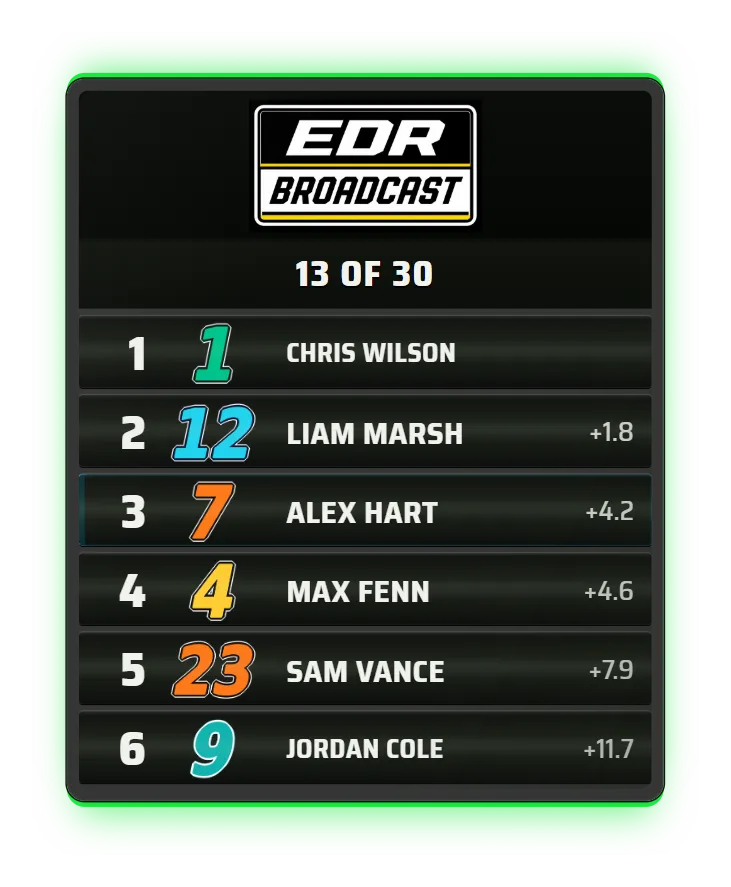
Oval broadcasting is a race-procedure problem before it is a graphics problem. Run a scoring pylon rather than a scrolling timing tower, show the stage plan when the league uses stages, keep a persistent caution count, identify the free pass and wave-around under yellow, use car-number artwork alongside driver names, and save story graphics for cautions rather than leaving them on air. This guide covers oval and stock car style league broadcasts in iRacing.
Which oval graphic are you missing?
Running order for a full field
A 30 or 40 car oval field will not fit in a readable tower. A scoring pylon pins the leaders and cycles the rest, so the top of the race never disappears while positions 21 to 40 are shown.
Stage state
When a league uses stages, viewers need to know which stage is running, how many laps remain and when the stage break is coming. That belongs in the pylon header plus a small laps-to-stage-end chip.
Caution state and caution history
These are two separate jobs. The board should read as yellow the moment the caution flies, and a small persistent bug should carry the running caution count for the whole race.
Free pass and wave-around
This is one of the easiest oval procedures for viewers to lose track of. Name the car that gets the lap back, list the cars waved around, and use your league’s own wording rather than assuming everyone says the same thing.
Restart lineup
Double-file restarts are a set piece. A restart grid graphic in the closing laps of a caution is often the most watched ten seconds of the yellow.
Superspeedway packs
At a superspeedway, position is less useful than pack shape. A draft-pack strip that clusters cars by physical track order tells the story that a positional list cannot.
Story stats
Laps led, lead changes, cautions for laps. These are yellow-flag graphics, not permanent furniture. Show them when there is time to read them.
What oval graphics do that a road-course tower does not
Stage structure
When stages are part of the format, the race becomes a series of segments with points and scheduled breaks. The graphics should always make the current segment clear.
Caution economy
Yellows reset the race. Laps lost, laps returned, pit cycles and restart order all matter more than a tenth of a second in sector two.
Track position over gap
On a short track or a superspeedway, a small time gap may say little about the battle. Position, lapped traffic and pack membership carry more of the story.
Identity by number
Car numbers are often recognised faster than surnames in oval racing. Number artwork on every row helps viewers identify a car at a glance.
Each of those jobs needs its own visual treatment and trigger. That is why an oval package is not simply a recoloured road-course theme: the layout, data column and flag behaviour all change.
What the Oval Pylon theme puts on screen
Oval Pylon is the EDR Broadcast US oval look: near-black plates with a faint olive tint, silver type and a bright green edge glow, built around a scoring pylon rather than a scrolling tower.
Fixed top ten, rotating field below. The leaders stay put while lower pages of ten cycle underneath, so the whole field gets screen time without the top of the race moving. A rule under position ten divides the two panes.
Every source shows the same page. The rotation is derived from a shared clock rather than pushed as a message, so the control preview and each OBS browser source land on the same page with no drift.
A stage header. Event title, series strip, laps complete and the current stage, with an optional league or event logo panel above it.
Full-body flag takeovers. Yellow, green and chequered states take the board rather than tinting one corner, with four caution animation styles and adjustable sweep speed and hold time.
Car-number artwork. A default 0 to 99 number set ships with the theme, and leagues can upload their own artwork per number and keep separate number profiles for different championships. Plain styled numerals are the fallback.
A selectable data column. Gap, interval, last lap, best lap, positions gained, manufacturer or a car image. Auto mode shows the gap under green and the car under caution. Pit, out and laps-down status always wins over the selected value.
Operator dials, not code. Left or right anchoring, plate opacity, glow intensity, number scale, rotation interval, pause and pin a page, or run the header alone with no rows at all.
The oval overlay set, by job
| Overlay | What it shows | When to use it |
|---|---|---|
| Scoring pylon | Running order, fixed leaders plus rotating field, stage header | The permanent board for the whole race |
| Stage counter | Current stage and lap, counting down to the stage break | Green-flag running, especially the ten laps before a break |
| Caution counter | A small persistent count of full-course cautions | All race, in a corner of the screen |
| Free pass and wave-around | The car getting its lap back plus the cars waved around, with your league’s own wording | Under caution, before the restart |
| Restart grid | The double-file lineup for the coming restart | Late in the caution, once the order settles |
| Draft packs | Packs clustered by physical track order, with car counts and gaps between them | Superspeedways, green-flag running |
| Laps led | The dominant leader’s number, name and laps led | Under caution or at a natural lull |
| Race recap | Lap N of M, leader, cautions for laps, lead changes | Stage breaks and mid-race resets |
| Pit pop-up | Stacked stop timings as cars cycle through the pits | Every pit cycle, green or yellow |
Pit stops stack rather than replace each other, so a caution cycle reads as a sequence: lane time, stop time and the positions each stop won or lost.
One stage plan should drive the graphics and the caution
A common oval production error is a stage plan that lives in two places. The graphics say the stage ends on lap 50 because someone typed 50 into an overlay, and race control throws the caution on lap 52 because someone else typed 52 into a spreadsheet. Viewers notice immediately.
In EDR Broadcast the stage laps are entered once. They can be derived automatically or set manually, and the same plan can optionally arm Auto Race Control so the entered laps drive both the on-air stage header and the actual caution. That arming is off by default: the graphics are display-only until you deliberately switch it on, which is the right default for a first event.
Whatever tool you use, the rule holds. Keep one source of truth for stage laps, verify it in practice before the race, and plan for what happens if a natural caution lands one lap before a scheduled one.
Arm the right overlay at the right moment
| Race phase | On air | Why |
|---|---|---|
| Pre-race and grid | Grid intro, event header, stage plan | Set the format before green so the stage graphics make sense later |
| Green-flag running | Pylon, stage counter, caution bug, packs at superspeedways | Continuous state only. Keep the frame clear for racing |
| Caution thrown | Yellow takeover, then pit pop-ups as the field cycles | The board should read as yellow instantly, not after a page rotation |
| Mid-caution | Free pass and wave-around, laps led, race recap | This is usually the best window for a readable stat card |
| Restart approaching | Restart grid, then clear the frame | Show the lineup, then get out of the way before green |
| Stage break and finish | Race recap, results, podium | Segment endings are the natural place for summary graphics |
Story graphics such as laps led and the race recap can be armed to reveal on a caution and hide themselves again after a set hold. That reduces the risk of carrying a stat card into the restart.
How EDR Broadcast handles the oval look
Oval Pylon is a built-in theme. Selecting it changes the board type rather than just the colours: the pylon replaces the standard timing tower in race sessions, and the supporting oval overlays inherit the same plate, glow and number treatment so the package reads as one show.
New overlays ship switched off. Nothing appears on your stream because you updated the app. You arm each oval overlay in settings when you want it, which is deliberate: an overlay that turns itself on during a live broadcast is a worse problem than a missing one.
Oval Pylon is part of Pro, which includes all 15+ public themes, race control and Auto Race Control. You can rehearse the complete oval package on the 14-day Pro trial, started inside the app with no card required. League adds connected-crew features on top, including remote browser control and public live timing; a read-only live timing page means the pylon does not have to answer every question on screen. See pricing for the full comparison and check the known issues before a championship opener.
The oval race-night rehearsal
- Enter the stage laps once, and confirm the header and the stage counter both read what race control expects.
- Load the entry list and check every car number resolves to artwork, not a text fallback.
- Run a full rotation cycle with the real field size and confirm the lower pages stay readable at stream bitrate.
- Throw a test caution and confirm the pylon changes state immediately and clearly.
- Check the free pass wording matches your rulebook. If your league says lucky dog, the graphic should say lucky dog.
- Rehearse the restart sequence: show the grid, clear the grid, then leave a clean frame before green. Rehearse the caution and replay handoff at the same time.
- If you are at a superspeedway, confirm the pack strip clusters sensibly with the real car count before you trust it on air.
- Write down who calls each graphic, and what happens to the show if that person drops out mid-race.
Frequently asked questions
Do I need a different theme for iRacing oval broadcasts?
You need a different board type, not just a different palette. A scoring pylon with a stage header, caution takeover and number artwork carries oval information that a road-course timing tower has no place to put.
How do I show the lucky dog or free pass on stream?
Use a dedicated free-pass and wave-around banner under caution, and set the label to your league’s own wording. Show it once the order is stable, not the instant the yellow flies.
Will a scoring pylon fit a 40 car field?
Not all at once, and it should not try. A fixed top ten with rotating pages of ten keeps type large enough to read on a phone while still cycling the full field.
Do oval overlays work on road courses?
The pylon and stage graphics do. Some overlays are deliberately restricted by track type, such as pack clustering defaulting to superspeedways only, with an operator override if you want them elsewhere.
Which EDR Broadcast plan includes the Oval Pylon theme?
Pro. Oval Pylon is one of the 15+ public themes included with Pro, so you do not need League for it.
Can I use my league’s own car numbers and logos?
Yes. A default number set ships with the theme, and uploaded artwork replaces it per number. Number profiles can be switched between championships, and the header carries an event title and logo panel.